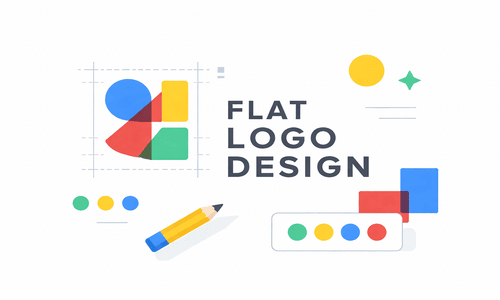
Have you ever noticed how famous brands like Google, Netflix, and Pepsi no longer use their iconic 3D logos? That’s because people are no longer interested in logos with realism and intricate details.
They want simple designs that are easier to remember and connect with. Plus, the fewer details your logo has, the more timeless and modern it feels.
The solution? Using a flat logo design. In this guide, we’ll explore what flat logos are and how to create a successful flat design logo, complete with examples from well-known brands for inspiration.
What is a Flat Logo Design?
A flat logo design is a two-dimensional brand mark without complex realism elements. These elements can be 3D effects such as gradients, shadows, and textures. As a result, flat logos include clean geometric lines and minimalist aesthetics that align with your brand’s values.
At first, flat logos emerged with the Swiss Style and Bauhaus movement of the 1900s. However, they have gained massive popularity after the release of Windows 8 and iOS 7, which adopted the flat UI logos for apps and interface icons. While these logos may look simple, they align perfectly with expectations of modern design trends and customers – thanks to their intentional design elements.
Key Characteristics of Flat Design Logos
Flat design in logos is defined by four key characteristics that give it a distinct look. When these elements work together, they can build a memorable and versatile brand mark that feels both modern and timeless.
Here are the key elements of a successful flat logo.
- Geometric Shapes: The shape defines your logo’s personality. In flat design, geometric shapes such as circles, rectangles, and ovals are used. And each represents a unique brand personality.
- Typography: Flat design includes simpler and cleaner font styles instead of decorative or complex typefaces. The goal is to make the logo more readable and easier to remember.
- Colors: Flat logos mostly include bright, solid colors. To make up for the simplicity of design, they use high contrast color combinations to keep the logo noticeable on different backgrounds and applications.
- Text Elements: When using text in a flat logo, go by the principle of “less is more.” The text should complement rather than overwhelm the clean aesthetic that defines a flat design.
Why are Logos Becoming Flat?
Over the years, major brands have shifted from using detailed realism logos to flat designs. But why are so many making this change? Let’s explore the key reasons flat logo design has become so popular.
1. They’re More Readable
According to Zippia, 75% of people recognize a brand solely by its logo. With attention spans shrinking fast, your logo has only a few seconds to make a strong first impression. Flat logos use minimal design and simple shapes. As a result, they are easy recognize no matter the type of medium, be it small or large, digital or print.
2. They Offer More Room for Color
Flat logo design does not use any gradients, shadows, or textures. Therefore, solid and bright colors are their strong forte. This is important because logo color psychology plays a major role in how people recognize and emotionally connect with brands. In fact, color has the power to increase brand recognition by as much as 80%, according to the University of Loyola, Maryland. Flat designs allow the colors to connect with your audience without complex effects competing for their attention.
3. They’re Easier to Adapt
Flat logos use simple shapes instead of finer and more detailed design elements. As a result, they are easier to scale at any size and work seamlessly across platforms and media. This means you do not need to spend time and money on a redesign when using them on digital or print.
4. They’re Both Trendy and Timeless
Minimalism is the new bold in modern design. Flat design logos with their clutter-free design and clean shapes align perfectly with the needs of the latest logo trends. At the same time, their simplicity keeps them relevant and engaging even as flat logo trends come and go.
The Best Flat Design Logo Examples for Inspiration
Understanding the advantages of flat logo design is one thing, but seeing it applied across real brands can bring its effectiveness to life. Let’s explore the best flat logos of famous brands and what they can teach us.
Facebook’s monogram logo was originally a small “f” placed against a gradient background. It had a 3D look much like the early 2000’s logos. With consistent and subtle changes over the years, the logo has evolved into the flat icon logo that we know today: a small “f” against a solid blue circular background. It’s the perfect flat design to use across social media, app interface, and print materials.

Burger King
Burger King originally had an iconic 3D burger icon and bold typography. But after its 2021 redesign, the logo is simplified into a flat design without gradients and unnecessary effects. It still has the brand’s name sandwiched between burger buns. But the typography looks just as juicy and plump as you expect the burger to be. And the design works well across all media, be it print, digital, or in-store signage.

Warner Bros
Warner Bros’ new logo still has its signature shield shape. But it no longer has the shadows and 3D look of their classic logo. Now, it’s a cleaner design that looks more modern while still staying true to the brand’s history and identity. It is also easier to read at smaller sizes and works better on digital screens. This update is a great example of how flat design can feel refreshing even for well-known and long-standing brands.

Tommy Hilfiger
Another excellent example is Tommy Hilfiger’s flat logo, which has simple geometric shapes and bold colors. While it has a minimal and clean layout, the colors bring in the contrast needed to make the logo more noticeable in the industry.

CNBC
For years, CNBC has used a flat design of a peacock with multiple colors, paired with clean typography. Right before 2026, the brand adopted a more minimal flat design. The peacock is removed and replaced by a small arrow pointing upwards. Moreover, Gotham has replaced the old typeface. The design is a lot cleaner and still feels engaging without complex design elements.

How to Design a Flat Logo for Your Brand
Now that you’ve seen how popular brands are using flat logos, you can take inspiration from these and use them to design your own. Creating a logo’s flat design is easy, as long as you know your brand’s core values and purpose. Here’s a step-by-step guide to designing a memorable flat logo.
Step 1: Research Your Brand and Competitors
Before you start the design process, you need to understand what your brand stands for, what your core values are, and who your ideal customer is. At the same time, you want to study your competition and their design choices.
This sort of knowledge will give you a strong foundation to create a logo that not only aligns with the design expectations of your industry but is also easy to distinguish from your competition. But why does this matter?
Research by Promotique found that 36% of people recognize a brand by its logo. Therefore, your logo should have its own personality that makes it distinct from other brands and emotionally connects with your customers.
Step 2: Choose Your Shapes and Symbols
The next step is to select the right shape for your logo. Just like colors, different logo shapes carry different meanings. By choosing a shape that aligns with the message you want to convey, you can communicate more effectively with your target audience and reflect your brand’s core identity.
Additionally, some logo shapes are easier to recognize than others. For instance, research published on PubMed shows that the human brain can identify circles more quickly than downward-pointing triangles. On the other hand, angular logos are perceived as masculine or strong, according to a study by Copenhagen Business School. This makes them an excellent choice for brands that want to convey power and stability.
Step 3: Select Your Typography
After choosing a logo shape, you need to pair it with the right fonts that complement your logo design and reflect your brand voice. As the flat modern logos have fewer visual details, typography does the most heavy lifting. This can be particularly useful for types of logos with wordmark or combination marks that pair words with symbols.
That said, you can choose any font style that goes well with the other design elements of your logo. However, make sure the font has a modern feel that aligns with the simplicity of a flat design. A neat typeface like sans-serif is an excellent choice, which up to 367 out of the Fortune 500 companies use, according to Website Planet.
Step 4: Develop Your Color Palette
Colors can have a strong emotional impact on people. And that’s why it’s important that you understand the fundamentals of color theory and how to use it strategically to influence how your customers perceive your brand.
However, a flat logo does not include too many colors as it doesn’t play with gradients or hyper realism. Instead of using multiple colors, you can choose one or two color combinations that match your brand’s personality. At the same time, it’s important to use contrast to differentiate the symbols or shapes in your logo. A good approach is to first work in black and white to establish the right level of contrast before introducing color.
Step 5: Start Sketching
Once you have all the design elements in place, it’s time to sketch different variations of your logo. This is where you can explore ideas and move towards a final workable design before anything goes digital. The key is to be imperfect. Your first idea is almost never the best one.
But as you explore, you can find unexpected ways to refine and improve your design. When sketching, aim for 10 to 15 variations and play with shapes and typography. Then, gather feedback from your team and narrow the ideas down to three or five strong candidates.
Step 6: Design Digitally and Test Across Platforms
Now, it’s time to take your best sketches and turn them into professional digital logos. Most people will see your logo on phones, social media, and websites, not just on paper. Therefore, your logo needs to be easy to recognize, whether you want to use it as a small 16×16 pixel app icon or on a huge billboard.
To make sure your logo looks sharp at any size, you can build the logo as a vector file. Once the logo is digital, you can test it on different platforms to make sure it looks consistent everywhere it appears.
What do Logos Represent for Your Brand
A logo is the most customer-facing element of your brand’s visual identity. It introduces your brand to your ideal customer, makes a memorable impression, and builds a loyal following of customers. At the same time, it communicates your brand’s very essence and the reason for being.
Therefore, your logo is not just a great design. It becomes the face of your brand that effectively conveys which industry you belong to and what services you offer. Knowing these benefits, you want to make sure that your logo design fits perfectly with your brand’s personality and is timeless enough to last through changing trends.
Final Words
To sum up, a flat logo design is a minimal logo without any 3D elements. The use of geometric shapes and solid, bright colors makes it both modern and timeless. Famous brands use flat logos to build brand recognition and ensure easy adaptation across different media.
That said, creating the perfect flat logo is no simple task. It requires a deep understanding of both branding and graphic design. At PNC Logos, we help you build a memorable logo for your brand. Our team conducts thorough research on your industry and competitors to design a logo that not only sets you apart but also communicates your core values. Contact us today to create the ideal logo for your business!