Today, 25.11% of Google searches show an AI-generated answer directly on the results page, as per a Conductor 2026 Article.
And Google isn’t the only place people search anymore.
Millions now ask AI tools directly. ChatGPT alone gets over 5 billion monthly visits and ranks as the fifth most-visited platform globally, according to SEMRush Data.
Which means something big has changed:
Your ideal customer may get the answer without ever visiting your site. And if your brand isn’t mentioned in that AI-generated answer, you simply don’t exist to the searcher.
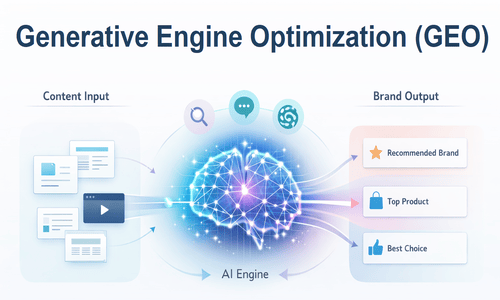
Generative engine optimization (GEO) helps position your content so AI platforms cite, recommend, and reference your brand. This article breaks down exactly what GEO is, how it differs from traditional SEO, and the specific strategies you can act on today.
What is GEO?
Generative engine optimization (GEO) is a modern SEO technique that includes structuring and positioning your content so AI-powered platforms like ChatGPT, Google AI Overviews, and Perplexity can cite, reference, or recommend your brand when answering user queries.
To understand what GEO actually means in practice, let’s consider an example. When you type “best CRM software for small businesses” into Google, you get a list of blue links to visit individual websites to find the relevant information.
But when you type the same query into ChatGPT, you get a synthesized answer. It names specific brands and explains why they’re recommended, without sending you to a search results page at all. GEO helps ensure that your brand is one of the names in that AI-generated answer.
To learn more about how AI systems work, read our complete breakdown of AI search algorithms and how they affect traditional SEO.
Why Do Brands Need to Invest in Generative SEO?
Generative AI SEO helps your brand stay visible in all AI search platforms beyond just Google. So, you get more channels for discoverability. At the same time, you increase your chances of appearing in Google’s AI Overviews and AI Search Mode.
The following data explains why GEO is becoming important for brands.
- According to the Pew Research Center, only 8% of users click on the standard search results below an AI-generated summary at the top of Google’s search results page.
- Data from Capgemini Research Institute shows that 58% of people now use AI tools to discover products and services. Two years earlier, only 25% of people reported doing the same.
- Another study by Capegemini found that 64% of consumers say they are willing to purchase a product that an AI system recommends.
- A 2025 research from Ahrefs found that 63% of websites already receive traffic from AI-powered search engines, even if those websites have not intentionally optimized their content for AI search.
These numbers show that AI-driven search is already influencing how people discover brands and make purchasing decisions. Investing in GEO helps brands remain visible as search behavior continues to shift toward AI platforms.
Generative Engine Optimization vs. Traditional SEO: What’s Actually Different?
The main difference between SEO and Generative AI SEO is the focus. SEO aims at traditional search rankings on the SERPs, while GEO targets AI search visibility. This translates into the following key differences.
- Keyword-first vs. entity-first thinking: Traditional SEO revolves around semantic keywords, their placement, density, and context in content. Generative Engine Optimization shifts the focus toward entities and clear answers. AI systems analyze context, user intent, and meaning rather than only counting whether a keyword appears on the page.
- Measuring success: With SEO, we track keyword rankings, click-through rates, and organic traffic. GEO measures are different. It focuses on how often AI cites your content, the share of brand mentions in AI responses, the tone of those mentions, and the quality of traffic coming from AI platforms.
- Authority signals: SEO relies heavily on backlinks and topical authority to boost credibility. Generative SEO adds another layer. Brand mentions, whether in reviews, forums, or news articles, count too. AI systems see these references as signals of authority, even without hyperlinks.
- Content format: SEO-focused pages can be long and detailed. On the other hand, GEO content must be easy for AI systems to extract and quote. This means clear headings, direct answers to questions, comprehensive paragraphs that work on their own, and a logical structure that AI models can analyze accurately.
- Maintenance frequency: A strong SEO page can hold its ranking for months with minimal updates. GEO content moves faster. According to a Zenodo study on AI Visibility Index, 40 to 60% of brand sources cited in AI responses can change every month. If your content isn’t refreshed regularly, it risks losing AI citations.

How Do AI Engines Decide What to Cite?
Search engines like Google use ranking algorithms, such as PageRank, to sort web pages by authority and relevance. Generative AI engines work a bit differently. They use tools called Retrieval-Augmented Generation (RAG) and semantic embeddings. These tools gather relevant information from multiple websites, understand the context, and then blend it into a single response for the user.
So, what signals guide AI when it decides what to cite? Let’s look at the key factors.

E-E-A-T Standards
AI systems are trained using the same quality standards used by Google. They prefer content that shows real expertise through named authors, professional credentials, first-hand knowledge, and references to reliable third-party sources.
Research conducted by Princeton University and Georgia Institute of Technology found that pages containing verified statistics and properly cited sources receive up to 41% more AI impressions than similar pages without those improvements.
Structured and Extractable Content
AI systems do not browse websites the way humans do. They analyze and parse page structure. Content that uses clear headings, direct answers, and a logical structure is much easier for AI to extract and quote correctly. Technical tools such as Schema Markup and FAQ sections make this process even easier.
Unlinked Brand Mentions
Traditional search engine optimization often focuses on hyperlinks. However, AI systems also pay attention to brand mentions that do not include links. References in product reviews, news stories, forum posts, and community discussions can signal credibility, even when there is no direct link to the company’s website.
Multi-Platform Presence
Generative AI systems do not collect information only from official brand websites. In fact, platforms such as Reddit, LinkedIn, and YouTube are among the most frequently cited sources used by major language models. Listing a business on review platforms such as G2, Trustpilot, and Capterra also increases the number of places where AI systems can find and confirm information about the brand.
Practical Generative SEO Strategies to Build AI Visibility
Now that you know how AI systems cite sources in their answers, let’s see how to actually optimize for these citations. The following GEO strategies explain how to align your content with how these systems work. Work through them in order or prioritize based on where your biggest gaps are.
1. Structure Content to Be Answer-Ready
AI systems locate information in a way similar to how a researcher quickly scans an article. They look for clear questions followed by direct answers. If a page forces the system to work hard to understand the context and meaning, the system will ignore it and look for another page that offers the answer more clearly.
As we understand this foundation, you’ll need to optimize your content to align with it. To do this, make sure that every main section begins with a question written as an H2 or H3 heading. Then, right after the heading, provide a short answer within one to three sentences. Follow that with a more detailed explanation and supporting information. This format matches the pattern AI systems commonly follow when combining information to produce a response.
2. Build and Highlight E-E-A-T Signals
Just like Google, AI platforms are trained to look for content that shows genuine expertise and originality. That’s where the EEAT signals become helpful. Simply put, you’ll need to demonstrate real experience and direct first-person insight in your content.
You can also show command over the topic by including statements with original research, client case studies, or quotes from qualified professionals instead of reusing information from other sites.
Also, make sure to include verified author credentials to make your site appear more reliable and trustworthy. In addition, your content pages should also include an author byline with credentials that can be checked.

3. Build a Multi-Platform Brand Presence
Think of your website as just one piece of the puzzle. AI systems aren’t looking at it alone. They’re also scanning Reddit threads, LinkedIn posts, YouTube videos, industry articles, and review sites to gauge your brand’s credibility.
The key? Show up as a helpful, trustworthy voice in multiple places, not just a polished promotional listing. The more contexts where your brand is genuinely recommended, the more likely AI is to cite it.
To optimize for Generative SEO, Start by picking 3 to 4 platforms where your audience actually hangs out. Then, commit to sharing genuinely useful content at least twice a month. Focus on quality over quantity—deep, meaningful posts beat frequent shallow ones every time.
4. Earn Unlinked Brand Mentions
In traditional SEO, a mention without a link barely counts. But in AI-driven search, it matters a lot. Systems read brand mentions across reviews, news articles, forum discussions, and community posts as credibility signals, even without a hyperlink.
Customer reviews on platforms like G2, Trustpilot, Capterra, and Google are especially valuable. These are trusted sources that AI already references. A brand with 200 detailed, specific reviews across three platforms sends a much stronger credibility signal than a sleek website with few third-party mentions.
5. Use Schema Markup and Technical GEO
If AI can’t understand your content, it won’t cite it. No matter how good it is. That’s where structured data comes in. Things like FAQ schema, HowTo schema, and Article schema act like a translator, making your content clear and readable for machines.
Technical GEO is just as important. You need to make sure AI crawlers can actually reach your site. Take a look at your robots.txt file and double-check that you’re not accidentally blocking GPTBot, PerplexityBot, or other AI crawlers. A good reference here is Microsoft’s official GEO/AEO guidelines. They spell out exactly what generative engines need to index and highlight your content.
6. Publish Content That AI Can Cite
As we’ve established that AI likes credible information, you’ll want to post content that behaves like a trustworthy reference. This can be done by backing your content with facts and numbers, with links to original verifiable sources.
For instance, saying “AI search is growing rapidly” won’t get you cited. But if you write, “As of Q1 2026, 25.11% of all Google searches trigger an AI Overview, according to Conductor,” that’s the kind of detail AI actually uses. It’s all about giving AI something solid to point to.
How to Measure Your GEO Success?
Measuring GEO success isn’t as simple as getting a rankings report, but it’s definitely doable. The trick is knowing which metrics matter and where to find them.
Start with what you already have. In GA4, AI referral traffic shows up in the referral reports under sources like chat.openai.com, perplexity.ai, and gemini.google.com. Make sure to segment this traffic separately.
From there, layer in GEO-specific metrics:
- AI citation share: How often your brand shows up in AI responses for relevant queries.
- Brand mention sentiment: Whether AI platforms present your brand positively, neutrally, or negatively.
- Prompt-based tracking: Running target queries manually on ChatGPT or Perplexity to see if your brand is being mentioned.
Tools like Semrush AI Visibility Toolkit, Conductor, and Profound are all built around these metrics. If you have the budget and have already invested in GEO, these tools are worth exploring.
Final Words
Generative engine optimization, or GEO, ensures that your brand is mentioned in AI answers. To optimize for AI searches, you’ll need to align your content with E-E-A-T signals, structured data, and have a strong presence across multiple platforms. This can be difficult to do on your own. If you want a strong GEO and SEO plan for your business, working with a professional SEO agency make a big difference.
PNC Logos is an experienced digital marketing agency in Orlando with a proven track record of creating data-driven strategies for businesses in all kinds of industries. Our team keeps up with the latest algorithm updates to help you stay competitive in today’s AI search landscape. Reach out today to get started.