Should you invest in SEO, run paid ads, or do both?
It’s one of the most consequential decisions in digital marketing. That’s because search engines are where customers go when they’re ready to act, and your visibility there directly shapes your growth.
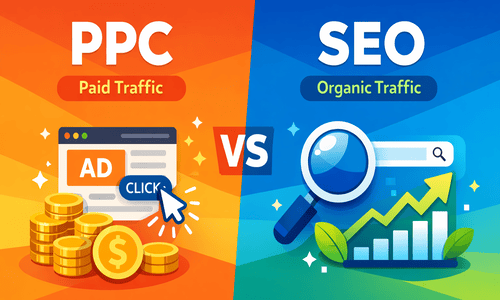
PPC vs. SEO sits at the center of this decision. Both are powerful. Both are proven. But the question is what each does best, and when one is better for your business.
This guide breaks down the advantages of PPC and SEO strategy, where the genuine differences lie, and how to choose or combine both to build a strong search presence.
What Is SEO in Digital Marketing?
In simple terms, SEO is about optimizing your website so it shows up higher in organic search results on platforms like Google or Bing. When someone searches for a product, a service, or simply an answer, SEO is what decides if your website appears and how visible it is.
At its core, it covers various interconnected strategies, including topical authority, keyword targeting, content quality, technical optimization, and more.
Why Does SEO Matter?
So, what makes SEO so important for building a strong digital presence? Organic search drives about 53.3% of all web traffic, according to BrightEdge. That is a huge share. But AI Overviews are changing the search landscape, as about 8% of users click through to a website when an AI summary is shown, according to the Pew Research Centre.
However, data from SEMrush shows that nearly 60% of keywords triggering AI Overviews are low-volume queries with 100 or fewer monthly searches. These are typically informational and more specific long-tail queries.
For these queries, the goal should be to get your content cited in AI Overviews instead of focusing only on clicks. Compared to the early days of AI-generated summaries, this has become much feasible now that we understand how generative SEO works. With GEO, you can keep your brand visible right where users are already looking for answers.
What Is PPC Advertising?
PPC stands for pay-per-click. In simple terms, it is a paid marketing tactic where businesses pay only when someone actually clicks on their ad. It’s a performance-based model. The main platforms here are Google Ads and Microsoft Ads.
Advertisers bid on keywords relevant to their products or services, set a daily or monthly budget, and have their ads displayed at the top or bottom of the search results page, clearly marked with a “Sponsored” label.
Why Does PPC Matter?
So, why does PPC matter so much? The answer is timing. You’re reaching users right when they’re searching with intent. In fact, about 64.6% of people with a high commercial intent click on a Google Ad, according to WordStream.
AI Overviews have also affected the PPC landscape. According to SEMRush, 95% of the keywords with AI Overviews have little commercial value or display no ads. Moreover, commercially important keywords with a CPC higher than $2 aren’t affected by AI summaries.
However, where AI Overviews do appear, like in the tech industry, CPC has markedly increased, according to research by Adthena.
PPC vs. SEO: Understanding Their Key Differences
The difference between PPC and SEO runs deeper than the familiar ‘paid vs. free’ framing. At its core, what you’re deciding is how much control you want over your visibility, and how fast you want results.

Here’s how the two strategies differ.
Speed of Results
A PPC campaign can drive qualified traffic within hours of launch, making it ideal for businesses that need visibility now. SEO works differently. It is a longer investment that requires consistent effort over three to six months before you see meaningful ranking improvements. The trade-off is that once you earn those rankings, they tend to stick, even if you stop investing for a while.
Cost Structure:
PPC is a pay-as-you-go model. The moment you stop spending, your traffic stops too. In comparison, SEO is more of a long-term effort. You build optimized content and backlinks, and those assets can keep generating traffic over time without continuous spending.
SERP Visibility
PPC ads show up in those top “Sponsored” spots. SEO competes for the organic traffic in the listings below. That said, paid ads can give you immediate traction for the targeted search terms as long as they run. Meanwhile, organic rankings capture more attention over time, especially as your brand gathers more authority in your niche.
Trust and Credibility
According to Reboot Data, about 70% of people prefer clicking on organic search results. They often see them as more credible and authoritative. That said, PPC shines in high-intent searches. If someone types “buy running shoes online” or “emergency plumber near me,” they’re ready to act. In those cases, paid ads perform extremely well.
Control and Targeting
This is where PPC really stands out. There are many PPC tools you can use to control who sees your ads based on keywords, location, device, time of day, and even demographics. SEO doesn’t give you that level of precision. Instead, it focuses on building relevance and authority over time, which leads to broader and more scalable reach. But with less real-time control.
The Advantages of SEO: Building Long-Term Authority
SEO sets the foundation for a sustainable digital visibility. And its most powerful quality is that its benefits compound over time. Here are the key benefits it offers.
- Cost-effective: Although SEO is a long-term investment and highly strategic, once your page ranks well organically, you keep getting clicks. And you’re not paying for every single visit like you would with ads.
- Trust and Credibility: People naturally trust the top organic results. And as your brand consistently shows up in top spots, people see you as more authoritative and a go-to resource for finding answers. This not only brings more traffic to your site but also makes the visitors more likely to convert.
- Return on Investment: When executed well and done consistently, SEO delivers the most ROI for your efforts. According to HubSpot, SEO is still the most impactful channel for ROI by as much as 2% compared to email marketing and paid social content.
- Compounding Content Value: A well-optimized blog post or service page keeps attracting traffic for years. Over time, it gains backlinks, builds authority, and keeps growing, without extra spending. And now, with Google’s AI Overviews changing how results appear, strong and in-depth content is even more valuable. It can help your site show up directly in AI-generated answers, instead of just traditional rankings.


That said, you should know that none of this happens overnight. SEO takes patience. It takes consistency. But if you’re willing to invest in both, the long-term payoff is hard to beat.
The Advantages of PPC Marketing: Speed and Control
If SEO is your long-term investment, PPC is your fast-response engine. It gives you immediate visibility right when someone is actively searching. And that’s what makes it so powerful on its own.
Here are the key benefits it offers.
- Speed. A well-structured PPC campaign can drive qualified traffic from the very first day it goes live. So, it’s an indispensable option to use when you launch a new product or are promoting seasonal events or discounts.
- Precision Targeting. With PPC marketing, you’re not just reaching people randomly. You can target users based on keyword intent, location, device, time of day, demographics, and even past website behavior through remarketing or retargeting ads. Simply put, no other search channel gives you this level of control over who sees your message and when.
- Measurable and Scalable. With PPC, you can track every impression, click, and conversion in real time. You can clearly see what’s working and what’s not. That’s why 76% of brands view paid search as a reliable and expanding business driver. And about half plan to invest more, according to WordStream.
- Brand Awareness: There is also a brand-building dimension that often goes overlooked. Even users who see an ad without clicking still absorb the impression. According to WebFx, search ads can boost brand awareness by as much as 80%.
- Keyword Testing for SEO: PPC also supports SEO. Campaign data shows you which keywords actually convert. This means you can focus your long-term organic strategy on what truly works. In a way, PPC helps fund smarter SEO decisions.
Of course, there’s one big consideration: cost. With AI-driven search features taking over results pages, cost per click is rising across industries. So, managing campaigns carefully is critical to maintaining a strong return on investment.
SEO and PPC Marketing: Why the Smartest Businesses Use Both
The most successful digital marketing strategies use Search Engine Optimization and Pay-Per-Click together as a unified search marketing system. Together, they amplify the benefits of standalone SEO and PPC campaigns.

Let’s see how combining these strategies works.
- Double your SERP presence. Your brand appears in both paid and organic results for the same query. People see you twice on one page. While it may seem insignificant, repetition has the power to build familiarity and trust. And naturally, it increases the chances people will click on your site.
- PPC data refines your SEO strategy. High-converting keywords identified through paid campaigns become the most valuable targets for long-term organic content. The same goes for ad copy. If it drives strong click-through rates, you can reuse that messaging in your title tags and meta descriptions.
- SEO authority reduces PPC costs. Google’s Quality Score rewards well-optimized, relevant landing pages with lower Cost-Per-Click. In other words, good SEO practice directly improves the performance of paid campaigns.
- PPC fills the timing gap. SEO takes time to build momentum. PPC starts delivering traffic and leads immediately. While your organic rankings grow in the background, paid campaigns keep things moving. Then, as SEO gains traction, you can reduce spending on those keywords and shift the budget elsewhere.
So, the real question isn’t PPC vs. SEO. It’s how to balance both based on your goals, your stage of growth, and your budget.
Which is Right for Your Business Right Now?
If you’re just starting out or stepping into a highly competitive niche, it’s best to use both PPC and SEO together. This combination helps you validate your market quickly while your organic rankings are still building. And realistically, SEO can take six to twelve months to gain traction.
But in the long-term, SEO on its own becomes incredibly powerful. It helps you build strong brand authority and steadily lowers your costs for customer acquisition. This is even more important if you belong to industries like healthcare, legal, or financial services.
In these fields, SEO helps you build the much-needed trust and authority. Your organic credibility will play a huge role in how people trust you, and that will directly impact your conversions.

At the end of the day, there’s no one strategy better than the other. Your budget, industry, competition, and timeline all matter. That’s why it’s important to evaluate where your business stands today, and where you want it to go. A skilled digital marketing team can help you map that out and decide how to allocate your resources more effectively.
Final Words
Summing up our PPC vs. SEO debate, both are proven strategies. But they work on different timelines and solve different problems. In 2026, things are more complex. Ad costs are rising, and AI is reshaping search engine results pages. The businesses that really stand out are the ones using both SEO and PPC together. The key is to start with a clear understanding of your situation.
If you’re ready to explore your options, working with a team that understands both sides of the equation can make a big difference. At PNC Logos, we offer dedicated SEO services and paid marketing solutions built to work independently or together as a unified search strategy. Get in touch now to find the best solution for your business.