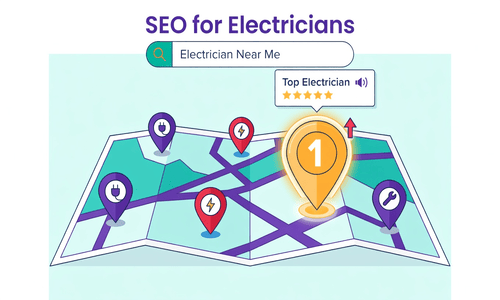
The top 3 organic search results receive 68.7% of all clicks on Google, according to FirstPageSage.
Businesses outside the top 3 are left competing over the remaining fraction of traffic. SEO for electricians helps you reach those top positions. It increases your visibility, builds trust with potential customers, and generates leads.
But how does SEO work? And what does it take to rank well in a competitive local market?
This guide explains both in detail. Whether you’re an independent electrician or a growing electrical contractor, you’ll get a step-by-step plan to improve your rankings and attract more local customers.
What is SEO for Electricians?
Search Engine Optimization, or SEO for electricians, is the process of improving your online presence so people in your service area can easily find your business when they need electrical work.
For example, when someone searches “emergency electrician in Chicago,” Google quickly decides which three businesses appear at the top of the Google Map results and which ones show up much lower in the search results. Your goal is to be one of the top listings that customers see first.
Five electrician SEO strategies can help you rank higher and get more customers:
- Keyword research to find terms your customers are searching for.
- Local SEO to dominate your local service area.
- On-page SEO to improve your web pages.
- Technical SEO to fix your site’s technical foundation.
- Off-page SEO to build authority beyond your website.


Now let’s look at these practical strategies in detail and how they can help.
Keyword Research: Map What Your Customers Are Actually Searching For
Keyword research helps you find the exact words and phrases your potential customers type into Google. Once you know these terms, you can build your website content around them so people can easily find your business.
There are three main types of keywords to focus on for electrician SEO.
Service Keywords
These target customers who are ready to hire someone. Examples include “panel upgrade,” “EV charger installation,” and “ceiling fan installation.” These are short and specific searches. The person already knows what they need and is looking for a professional to do the job.
Local Keywords
These are the most valuable because they show a strong intent to hire. Examples include “licensed electrician in Denver” or “emergency electrician in Midtown.” These searches combine a service with a location. Your main service pages should focus on these keywords because they often lead directly to phone calls or booking requests.
Problem or Symptom Keywords
These are used by people who have an issue but are not ready to hire yet. Examples include “circuit breaker keeps tripping” or “what causes flickering lights.” These are good topics for blog posts and FAQ pages. Helpful content can build trust and encourage people to contact you later.

Free Tools to Find Keywords
You can find useful keywords without paying for tools by using the following:
- Google Autocomplete: Type a phrase like “electrician in [your city]” into Google. Write down the suggestions that appear.
- People Also Ask: Related searches found in the Google search results page.
- Google Keyword Planner: It shows estimated monthly search volumes for different electrical services.
- Ubersuggest: In the free version, you can enter a basic term like “electrical services” to get a list of related keyword ideas.
- AnswerThePublic: It shows common questions people ask online. It is especially useful for finding ideas for FAQ pages and blog posts.
Once you have your keywords, you can use them across your content naturally. Just ensure to use semantically-related terms to avoid keyword stuffing.
Local SEO for Electricians: Own Your Service Area on Google
When someone searches for “electrician near me,” Google ranks businesses based on three factors: relevance, distance, and prominence. Local SEO for electricians helps you optimize for all three factors and rank higher in search results. As a result, you can position your business in a lucrative spot for receiving more phone calls and landing more projects.
Here’s what you’ll need to do.
Optimize Your Google Business Profile (GBP)
Your Google Business Profile is the most important factor outside your website for local rankings. It helps you show up in Google Map Pack for local queries and displays important info about your business, urging customers to contact you, review your services, or visit your website. In fact, 48% of interactions from a GBP include visiting the business website, and 17% are making a call, according to Birdeye.
After creating or claiming your GBP, here’s how to optimize GBP for these searches.
- Select the main category as “Electrician” for your business.
- Add related categories such as “Electrical Installation Service.”
- List all the areas you serve, including nearby towns, neighborhoods, and ZIP codes.
- Add each service you offer as a separate item, such as panel upgrades, EV charger installation, or home rewiring.
- Include photos of the before-and-after project, your team, and your equipment.
- Post updates once a week. Share information about completed jobs, special offers, or seasonal services.
Earn Local Reviews and Testimonials
Hyperlocal reviews have a strong impact on how your business ranks in local search results. Three things matter most:
- How many reviews do you have
- How recent are those reviews
- Whether you reply to every review, including negative ones
When you respond to reviews, you show both search engines and potential customers that you take responsibility and care about your service.
This is important because most people rely on reviews before choosing a business. According to a 2023 BrightLocal survey, 98% of consumers read online reviews for local businesses before making a decision. Getting regular, positive reviews is one of the quickest ways to improve your visibility in local search results.
NAP Consistency and Local Citations
NAP is a short term for your business Name, Address, and Phone number. These details must be exactly the same everywhere your business appears online. Even small differences, like writing “Street” in one place and “St.” in another, can confuse search engines and hurt your rankings.
Start by creating or updating your business listings on key platforms like Yelp, Angi, HomeAdvisor, the Better Business Bureau (BBB), and your local Chamber of Commerce directory. Make sure your business name, address, and phone number match perfectly across all of them.
On-Page SEO for Electrical Contactors: Optimize Your Web Pages
Your website’s content and structure tell Google exactly what you do, where you do it, and who you serve. On-page SEO for electricians helps you improve your pages so Google and your customers can understand your services more clearly.
Build a Dedicated Page for Every Service
Never bundle all your services onto a single page. Instead, give each core service its own dedicated page. This is the “one keyword cluster, one page” rule, and it’s one of the most important principles in on-page SEO.
For example, a page titled “EV Charger Installation in Phoenix” should focus only on that service in that city. Its goal is to rank in search results for people in Phoenix looking for EV charger installation and turn them into customers.
That page should include:
- A clear main heading (H1) with the target keyword
- A simple explanation of the benefits of the service
- A FAQ section that answers common questions
- A strong call-to-action for local customers
Use this same structure for every service you offer, such as panel upgrades, home rewiring, and emergency electrical services.

Optimize Each Page Element
After setting up your pages, make sure each part is properly optimized:
- Title tag: Include service + city + brand name. For example, “Emergency Electrician in Austin | XYZ Electric.”
- Meta description: Written between 150 and 160 characters. Include the service, the city, and a clear call-to-action like “Call for a free quote.”
- H1 tag: Use one H1 per page, and include your main keyword.
- Call-to-action placement: Put your phone number and contact form at the top of the page so visitors see them right away. Repeat the call-to-action at the bottom for those who read the full page.
Create Helpful Blog Content:
Blog content targets customers early in the buyer journey by addressing the problems they are facing, such as “What causes flickering lights,” “How to know if your home needs rewiring.” This type of helpful content can attract early-stage searchers and guide them to convert later.
The search landscape is shifting, too. According to the Pew Research Center, 34% of U.S. adults have used ChatGPT, and many of them are asking the same questions they’d previously typed into Google. Google’s own AI Overviews now answer queries directly at the top of the results page, pulling from authoritative content.
To stay visible in AI-driven search environments:
- Structure every blog post around one clear question
- Answer it directly early in your content.
- Use concise paragraphs that work on their own.
- Use natural language throughout.
- Structure your content with headings and schemas for context.
- Follow Google guidelines for EEAT standards.
Create Internal links and Topic Clusters:
Internal linking pages helps you distribute authority from one high-performing page to other related pages on your site. This ultimately improves the performance of these other pages as well. The best way to do this is to create topic clusters by linking related pages to a central pillar page.
For example, a pillar post about “The Complete Guide to Home Electrical Safety” can link to supporting posts such as “Why Does My Circuit Breaker Keep Tripping?” and “How to Tell If Your Home Needs Rewiring,” with each linking back to the pillar. This tells Google that your site covers the topic comprehensively, which enhances your topical authority and rankings across the entire cluster.
Technical SEO: Fix Your Website’s Foundation
Your website may have great content. But if there are technical problems behind the scenes, Google will not rank it well. Technical SEO for electricians helps search engines properly crawl and index your website in search results, ensures a better user experience to keep people on your pages longer, and improves your rankings, as user experience is a Google ranking factor.

Here are four technical areas to improve in SEO for electrical contractors.
Page Speed (Core Web Vitals)
A slow website is like undersized wiring where everything technically works, but performance is being throttled the whole time. Google’s algorithm actively penalizes pages that take too long to load. According to Google PageSpeed Insights, a load speed under 800ms is considered good, and between 1800ms and 3000ms needs improvement. The most common culprits are uncompressed images, cheap hosting, and too many bloated plugins.
Mobile Responsiveness
Over 51.62% of worldwide website traffic comes from mobile devices, according to data from StatCounter. And 88% of people who search for a local service on their smartphone visit a business within a week, based on data from Google.
Therefore, your website must display properly and be easy to use on smartphones and tablets. If visitors have trouble reading or navigating your site on a phone, they will leave quickly. This will not only increase your bounce rates but also give your competitors an advantage.
SSL Certificate (HTTPS)
Websites without HTTPS are marked as “Not Secure” by Google. This warning can make visitors lose trust immediately. In addition, HTTPS is a confirmed ranking factor, so secure websites have an advantage. Make sure your site has a valid TLS certificate and uses HTTPS on all pages. You can use free services like ZeroSSL or Let’s Encrypt. Paid options include DigiCert or GlobalSign.
Local Business Schema Markup
Schema markup is a type of code added to your website that gives Google context about your business. You can use schemes like LocalBusiness, Service, Review, and FAQPage in a format called JSON-LD, and add to any page without changing anything visitors see on their screen.
Off-Page SEO: Earn High-Quality Backlinks
Google looks at links from other websites as signals of trust. These links are called backlinks. When a trusted website links to your site, it passes some of its credibility to you. This helps your website rank higher in search results.
Here are some practical ways a local electrical contractor can earn these links:
- Supplier Partnerships: Apply to installer programs from companies like Leviton, Siemens, or Square D, which often list certified installers online.
- Local Associations: Join your Chamber of Commerce or groups like the National Electrical Contractors Association to get a business profile with a website link.
- Home and Real Estate Blogs: Contribute articles to local real estate agents or home improvement blogs in exchange for a website link.


Final Words
When done correctly, SEO for electricians can help you attract more local customers and land more electrician jobs. Be sure to regularly track your SEO performance and adjust your strategies based on what’s working and what’s not.
Managing an SEO campaign can be a complex process that requires strategic thinking and plenty of time investment. A professional SEO partner can handle this workload on your behalf so you can focus on your business.
PNC Logos is an SEO agency based in Florida dedicated to helping small businesses increase visibility and grow through comprehensive, tailored SEO strategies. Contact us today to build a custom SEO plan that works for your business.