Topic clusters can increase your organic traffic by about 30%. They also help your search rankings last 2.5 times longer, according to HireGrowth.
But why?
Topic clusters and pillar pages not only improve your site’s structure but also boost your topical authority. As a result, search engines see you as an authoritative figure in your industry and give you better search rankings.
But how do you implement these pages in your SEO strategy?
In this guide, you will learn what topic clusters and pillar pages are, real-world examples, and how to build your own topic cluster content strategy from scratch.
What are Pillar Pages?
In SEO, a pillar page is a long, comprehensive page that explains one main topic in detail. Its purpose is to give readers a clear overview of the subject and introduce all of the key areas related to it. Instead of focusing on many different topics, a pillar page stays centered on one specific subject and explains its main parts.
This type of page is often the first resource a reader visits to understand a topic before exploring more detailed articles. For that reason, in modern SEO, these pages are used to link to other pages on the same website that provide deeper explanations of specific subtopics. Because it connects to these related articles, the pillar page serves as the central hub of the website’s content structure.
What are Topic Clusters?
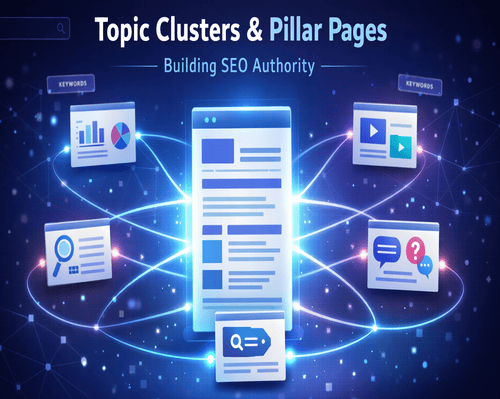
A topic cluster is a group of related pages that link to and support a main pillar page. The pillar page covers a broad subject, while each cluster page focuses on one specific part of that subject.
Every cluster page explores a single subtopic mentioned on the pillar page. It provides more detailed information, answers more specific questions, and targets narrower search queries.
For example, a pillar page may include comprehensive information about the overall concept of email marketing. A cluster page linked to this pillar will focus only on one sub-topic, such as “how to write email subject lines that increase open rates.”
How Topic Clusters and Pillar Pages Work Together
Topic clusters and pillar pages are connected through a clear internal linking structure. Each cluster page links back to the pillar page, and the pillar page links to every cluster page. This two-way linking shows search engines how all the pages relate to one main topic. It also makes it clear which page is the main authority on the subject.
The connection does more than simply link pages together. If a cluster page receives backlinks from other websites or gets strong user engagement, some of that value passes through the internal link to the pillar page. This helps strengthen the pillar page and the entire group of related pages. The process works both ways. The pillar page also shares its authority with the cluster pages it links to. In this way, every page supports the others.

Why Topic Clusters and Pillar Pages are Important for SEO?
In the past, search rankings often depended on how well a page matched specific keywords. Today, Google favors websites that show deep and well-organized knowledge about a topic. Clusters and pillar pages are designed to support this approach.
Let’s go through the key advantages they offer.
They Strengthen Topical Authority
When your website covers a subject from a broad overview to detailed subtopics, search engines interpret this as expertise and great command over the topic. Together, SEO topic clusters and pillars show Google that your site provides complete and reliable information on that subject. This also helps align your online presence to Google’s EEAT standards. As a result, you become the go-to source for search engines and readers for finding authentic information online.
They Improve Content Discovery and Indexing
Internal links help search engines find and understand your pages. They guide search engine crawlers from one page to another and show how your content is related. A 2025 analysis of crawl logs from 84 e-commerce sites found that pages 1 click away from the homepage received an average of 2.3 per day, while pages 5 clicks away received only about 0.4 crawls per day. A pillar-cluster system keeps related pages close to the homepage and makes them easy for search engines to discover.
They Prevent Keyword Cannibalization
When several pages on a website target the same or very similar keywords, they can compete with each other in search results. This problem is known as keyword cannibalization.
Topic clusters solve this issue by giving each page a clear role. While the pillar page focuses on the main topic, each cluster page elaborates on a specific subtopic. This structure ensures that every page supports the overall topic instead of competing with other pages on the same site.
They Keep You Visible in AI-Generated Search Results
Search results are increasingly influenced by artificial intelligence. According to BrightEdge, AI Overviews appeared in 44.4% of search queries by September 2025, compared with 26.6% earlier the same year. Websites with pillar pages and topic clusters are cited more often in AI answers. Building this structure now helps ensure that your content remains visible as search technology continues to evolve.

Real Topic Cluster Examples to Inspire Your Strategy
Now that you have an idea of what topic clusters and pillar pages are, let’s review some real examples to make the strategy easier to understand. Below are some examples of how well-known companies organize their content using topic clusters.
1. Salesforce’s CRM Cluster
Salesforce uses a page titled “What Is CRM?” as the main pillar of its topic cluster. This page explains what customer relationship management (CRM) is, who uses it, and why it matters. From this main page, Salesforce links to several related cluster pages. These pages cover specific topics such as:
- Artificial intelligence in CRM
- Marketing sales
- Digital commerce
- Customer service interactions.
- CRM for B2B companies, etc
This structure creates a hub-and-spoke model. The pillar page provides the main explanation, and the cluster pages explore each related topic in more detail.

2. HubSpot’s Inbound Marketing Cluster
HubSpot uses its Inbound Marketing page as the pillar page for another strong topic cluster. The page explains the inbound marketing method, which focuses on attracting potential customers with helpful content instead of interruptive advertising.
The page links to many cluster pages that explain related tools and techniques, including:
- SEO strategy
- Inbound sales call
- Solution selling
- Social media listening


Together, these pages form a connected set of resources that explain the entire inbound marketing approach. At the same time, HubSpot is naturally linking to its own helpful product pages.

3. Healthline’s Guide to Fever Cluster
Healthline uses its Fever Guide as a pillar page for a medical topic cluster. This page explains the basics of fever, which is an elevated body temperature. The guide also covers comprehensive information about common causes, symptoms, treatments, and situations when a person should seek medical help.
The pillar page links to cluster pages about related health topics, including:
- Illnesses that cause fever, such as the flu or pneumonia
- Medications like antibiotics with a link to a detailed antibiotics side effect page.
- Detailed explanations of symptoms like shivering or skin rashes
- Prevention methods, such as proper hand washing
These connected pages create a structured knowledge base that helps readers understand fever and related health issues.

4. SEMRush’s Digital Marketing Strategy Cluster
SEMRush has a comprehensive Digital Marketing Strategies guide as its pillar page. This page introduces the main types of digital marketing used by businesses today. Moreover, it explains major channels such as search engine optimization (SEO), paid online advertising, Social media marketing, and more.
From this page, SEMrush links to many cluster pages that focus on specific topics, including:
- Keyword research methods
- Technical SEO improvements
- Competitor analysis techniques
- SEMRush’s product tools, such as the Keyword Magic Tool and Social Poster
This structure builds a large network of related content that helps users learn about every part of a digital marketing strategy.

How to Build an SEO Topic Cluster Content Strategy Step by Step
Building effective SEO topic clusters is not about publishing more content. It is about creating connected content that follows a clear structure. Follow these five steps in order to build a topic cluster strategy that you can implement.
Step 1: Choose Your Pillar Topic
Select a topic that is broad enough to support about 8 to 12 related subtopics, but specific enough to match your products, services, and target audience’s needs.
If you don’t know where to start, consider it from your audience’s mindset and needs. Ask yourself a simple question. “Could one detailed page on this topic serve as the main starting point for someone who knows nothing about it?”
- If the answer is yes, the topic can work as a pillar.
- If the topic is too narrow, there won’t be enough subtopics to support it.
- If the topic is too broad, the pillar page will lose focus and become difficult to organize.
Step 2: Audit Your Existing Content
Before creating new content, look at the content that you already have. List your blog posts, landing pages, and long-lasting evergreen articles. You might end up finding that you already have several useful pieces that could become cluster pages, but are not currently connected.
When reviewing existing content, you’ll need to go through these steps:
- Identify decaying content that can be updated or expanded.
- Combine overlapping articles that target the same keywords.
- Remove duplication that could cause keyword cannibalization, where multiple pages compete for the same search term.
Step 3: Map Subtopics Using Keyword Research
When planning content for a pillar topic, start by doing keyword research. This will help you find the questions, long-tail keywords, and related topics people search for within your pillar topic. Each of these subtopics should become one cluster page.
When identifying keywords, you’ll want to focus on:
- Specific, longer search queries for cluster pages.
- The broader, high-volume keyword for your pillar page.
This approach allows your content to appear in search results for both broad and specific searches, which will increase your overall visibility.
Step 4: Create and Structure the Content
Start by writing the pillar page, so that you can define the main topic and set the direction for the rest of your content. The pillar page should cover the entire subject broadly. However, do not go into deep detail about every subtopic.
Instead, it would be your cluster pages that focus on one specific subtopic related to the pillar page. For cluster pages, aim for about 1,200 to 1,800 words. Include reliable data and real examples so readers can understand and apply the information easily.
You’ll also need to manage these pages regularly. Doing this the traditional way, like manually in a spreadsheet, can become difficult as the number of pages grows. You can use a content cluster tool to make things easier.
When choosing a topic cluster tool, look for features such as:
- Keyword grouping and intent clustering
- Content gap identification
- Internal link auditing
- Pillar/cluster relationship visualization
It can be difficult to find all of these features in a single tool. However, several tools provide some of these functions. For example, you can use the HubSpot Content Strategy Tool, Semrush Topic Research, and Ahrefs Content Gap to help plan and manage a content cluster strategy.
Step 5: Build Bidirectional Internal Links
After publishing your content, connect all the pages in the cluster. Each cluster page should link to the pillar page, and the pillar page should link to every cluster page. Use clear anchor text that includes relevant keywords.
This two-way linking structure helps search engines and AI systems understand how the pages relate to each other. Internal linking has a measurable impact. A study of 23 million links by Zyppy found that URLs with more than 40 internal links get 4 times more clicks from Google than those with fewer links.
Final Words
Topic clusters and pillar pages are a long-term website structure that you build and improve over time. As you add more cluster pages and links, your site gains stronger topical authority and becomes easier for people to find in search results.
However, even the best strategy only works if it is implemented correctly. To get the best results, it helps to work with professionals who understand how to plan and manage this structure.
At PNC Logos, we provide professional SEO services designed to turn your topic cluster strategy into measurable, long-term growth. Our team handles keyword research, content planning, site structure, and full SEO implementation so your website can build authority in your industry. Contact us now to start building a stronger search presence.