32.8% of people look for brands through a search engine, according to DataReportal. And over 80% of qualified leads come from Google, based on research by Action Marketing Co.
This means your next customer will most certainly find you through a search result. If they land on your website, and your brand does not communicate credibility and value, that click means nothing.
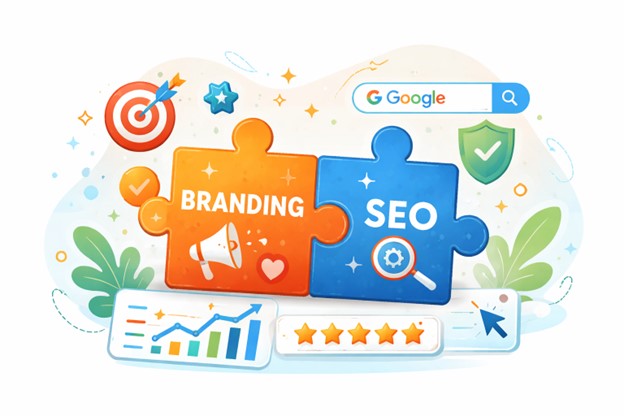
This is why branding and SEO must work together, so that your ideal customer not only finds you online but also trusts you enough to convert.
But how do you make it possible?
In this guide, you will learn how SEO and branding work together, why this matters, and the specific steps you can take to strengthen both at once.
What is Branding for Businesses?
Most people think branding means a logo, a set of colors, or a memorable tagline. In reality, your brand is the overall impression a customer has after every interaction with your business. It is created through every touchpoint, every piece of content, and every promise you make and keep.
A complete brand identity is built on four pillars.
- Visual Identity: Your logo, typography, color system, and image style. A strong custom logo design is often the first sign of professionalism a customer notices, but it is only a starting point, not the entire picture.
- Brand Voice and Messaging: The tone, language, and values you share across your website, social media, blog posts, and advertisements.
- Brand Promise: The clear result or benefit a customer expects when they choose you instead of a competitor.
- Reputation and Trust: The perception built over time through customer experiences, reviews, and your overall public presence.

In short, branding shapes how people feel about your business the moment they first see it. If you are not sure where to start, you can avail professional brand identity services to define your visual identity and align it with your brand voice, mission, and purpose.
What is SEO and What Can it Do for Your Business?
SEO, or search engine optimization, means improving your website and its content so it ranks higher on search engine results pages (SERPs). The goal is to increase organic, unpaid visibility so the right people find your business when they search for the products or services you provide.
When executed effectively, SEO provides measurable results for your business’s growth. According to Conductor’s State of SEO report, 91% of marketers think SEO improved both their website performance and overall marketing goals. Moreover, organic search makes up an average of 33% of total website traffic across seven major industries.
SEO works across three areas:
- On-Page SEO: Keyword research, high-quality content, clear title tags, accurate metadata, and internal links, basically everything on your site that helps search engines understand each page.
- Technical SEO: Load speed, mobile-friendly design, crawlability, and structured data. These are the background factors that decide whether search engines can access and index your site correctly.
- Off-Page SEO: Backlinks, brand mentions, and digital public relations, or the outside signals that show search engines your website is trustworthy and deserves higher rankings.
- Local SEO: If your business operates in a specific geographic area, such as a plumbing business, local SEO helps you reach customers in that location.

Many businesses work with SEO services in Florida or their local market to improve visibility in local search results. A local agency can better understand the competition and search behavior in that specific area, which can deliver much better SEO results.
How Do Branding and SEO Work Together?
The connection between branding and SEO is not one-directional. Each field directly supports the other and creates a cycle where a stronger brand improves SEO results, and stronger SEO builds a more recognizable brand.
Here’s how it actually works.
1. Brand Consistency Drives Higher Click-Through Rates
A great brand makes it easy for people to recognize their name, what they offer, and how they look visually. In fact, using a consistent color palette across logos, promotional materials, and content can make a brand 80% more recognizable, according to Forbes.
Moreover, when you appear the same way consistently in the SERP results, people are more likely to choose your link, even if it is not the first result on the page.
For example, if someone has already seen your brand on social media, heard a coworker mention it, or visited your site before, they are more likely to click on your link when they see it again in search results. Their previous exposure makes them feel more confident about choosing your website.
Searches that include your brand name are also important. When people type your company name directly into a search engine, it shows that they are actively looking for you. This tells search engines that your brand is known and trusted, which can support your overall search performance.
2. SEO Builds Brand Awareness at the Top of the Funnel
In the Conductor’s State of SEO 2025 report, professionals across all roles ranked “increasing brand awareness through SEO” as their top priority. And you can make it happen at the very start of the sales funnel. For many customers looking for a service or product online, the first time they will see your brand is in an organic search result on Google. This makes SEO a key starting point for attracting new customers.
At the same time, the pages that appear in search results set the foundation for a customer’s very first interaction with your brand. The way that page is written, including its tone, message, and explanation of what you offer, directly shapes how people remember your business or want to interact with your products or services.
3. Brand Authority Strengthens SEO Signals
To determine which pages to rank higher in SERP, Google evaluates content using its E-E-A-T framework, which stands for Experience, Expertise, Authoritativeness, and Trustworthiness.
They are signals Google collects from concrete evidence, such as who wrote your content, who links to you, who mentions you, and whether your messaging is consistent across the web. A strong brand naturally produces more of these signals.
It does this by publishing high-quality content with clearly identified authors, receiving mentions from trusted media sources, and communicating consistently across all platforms. As a result, it feels more trustworthy in the eyes of both users and search engines.
This connection between branding and SEO is becoming even more important. Research from Ahrefs in 2025 found that brand mentions across the web and the number of people searching for a brand name are linked to how often that brand appears in AI-generated search summaries. As search technology continues to change, strong brand signals are even more essential to help you stay visible online.

The Best Strategies to Align Your Branding and SEO
To make your SEO and branding work together, you need to go beyond the “publish good content and use keywords” practice. Instead, focus on these five strategies.
1. Define Your Brand’s Keyword Identity
Before using any keyword research tool, decide how you want people to see your brand. For example, decide if your brand is high-end or affordable, focused on a local area or a national audience, or led by experts or by a community. These choices should guide the keywords you select.
- A high-end brand should target terms like “luxury,” “premium,” or “custom.”
- An everyday, affordable brand should avoid terms like “enterprise solution” or “high-level consulting.”
To start, first write down your brand traits and match them with the types of keywords you will use. Then you can create content around those terms.
2. Create a Consistent Brand Voice Guide
The next step is to write a clear guide for your brand voice. This matters because today’s consumers are more value-driven.
You’ll need to define your tone (such as formal or friendly), the vocabulary you use and avoid, and the values that should come through in every piece of content. Then apply this guide to all your content, including blog posts, landing pages, and product descriptions.
This way, you can keep your messaging consistent. At the same time, you can ensure that your page not only ranks well in search results but also feels connected to your brand when users visit your site.
3. Focus on Brand Mentions, Not Just Backlinks
Backlinks are still important, but they are not the only factor that matters. The brand mentions that you earn across the web can strongly influence how often your content appears in AI-generated search results.
This means your brand should be mentioned in places like industry websites, podcasts, forums, and guest articles. Even if these mentions do not include a link, they still help your SEO performance.
4. Keep Your Brand Consistent Across Search Results
Make sure your brand looks the same everywhere it appears in search. This includes your business profile, page descriptions, search snippets, image descriptions, and any knowledge panels.
To ensure consistency, use the same business name, description, and visual style in all these places. If your information changes from one source to another, it can confuse both users and search engines. As a result, you will lose your credibility for staying visible in the search results.
5. Use Topic Clusters to Show Expertise
Rather than publishing content around whatever keywords have the highest volume, build content around the topics your brand wants to be known for. A pillar page supported by a cluster of related articles signals to search engines that your brand has deep and authoritative knowledge in a specific area.
Over time, that topical authority can further enhance your E-E-A-T signals and position your brand as the go-to resource in your niche. And this is exactly what both Google and your audience are looking for.
How Do You Know If Your Branding Is Helping Your SEO?

You can monitor the following signals to see how your brand efforts are affecting your search performance.
Let’s review these in detail.
- Branded Search Volume: Check Google Search Console to see how often people search for your exact brand name. If this number is increasing over time, more people recognize your brand and are actively looking for it.
- Direct Traffic Trends: Look at your website analytics to track how many visitors type your full website address directly into their browser. This shows strong brand awareness. Compare this number with your organic search traffic to see if both are growing together.
- Engagement Metrics on SEO Content: Check metrics like time-on-page, scroll depth, and return visit rate. If users consistently bounce from your highest-ranking pages, there is likely a disconnect between your SEO content and your brand experience.
- Sentiment in Brand Mentions: Use tools like Google Alerts to track when your brand is mentioned online. Pay attention to whether the mentions are positive, neutral, or negative. Positive mentions on trusted websites help improve your credibility with both users and search engines.
- SERP Real Estate Ownership: Search for your brand name on Google. Your official website should appear at the top. If competitors, ads, or negative reviews rank above your site, you need to address this quickly by improving both your SEO and your brand reputation
Final Words
To sum up, Branding and SEO are complementary strategies that grow stronger together. As AI continues to influence how search results are ranked and displayed, having a strong and recognizable brand is even more important now. So, if you are ready to build a brand that works hand in hand with your SEO, working with a professional can help you achieve measurable results.
PNC Logos is an Orlando Digital Marketing Agency that has helped many businesses, both locally and across the United States, reach their branding and SEO goals. We provide end-to-end branding and digital marketing solutions to help your brand feel more credible and compete effectively in search. Reach out now to find tailored solutions for your brand.