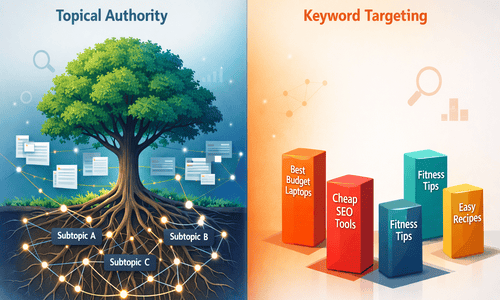
Imagine two competing websites in the same niche. One has over 50 blog posts, each targeting a single keyword. The other publishes half as much but links every post around a central topic.
Six months later? The second site still ranks on page one. The first? Ranked and disappeared.
That’s the whole essence of the topical authority vs keyword targeting debate. So, which approach will dominate content strategies in 2026 and beyond?
In this article, we will explore topical authority and keyword targeting. We will also compare what really drives rankings and how to prioritize or combine them.
What Is Topical Authority?
Topical authority in SEO means a website shows clear and consistent expertise across a complete subject area. It does this by creating a broad and well-connected collection of content that answers every important question within a specific field. When a website regularly explains a topic in depth, search engines start to view it as a trusted and reliable source for that subject.
How Google Evaluates Topical Authority
When deciding whether a website is a true subject expert, Google looks at four signals:
- Content depth: The site goes beyond simple definitions and basic explanations. It provides detailed examples, advanced ideas, rare scenarios, and practical guidance.
- Semantic relevance: The content uses accurate terminology. It addresses related concepts and clearly connects subtopics within the field.
- Internal linking structure: The pages link logically. They show how main topics connect to supporting subtopics.
- Coverage breadth: The site answers a wide range of questions. It covers beginner, intermediate, and advanced topics fully.


Is Topical Authority an Official Ranking Factor?
The answer is yes. In May 2023, Google published a blog post about News Topic Authority, acknowledging that it evaluates how deeply a publisher covers specific subjects when deciding credibility and ranking.
Additional confirmation appeared in 2024 when information from the Google Content Warehouse API document became public. The document revealed internal signals such as siteFocus and siteRadius.
SiteFocus measures how completely a website covers a specific subject. SiteRadius measures how far a website’s content extends beyond its main topic. Google uses these signals to assess topical authority at the entire website level, not just on individual pages.
What Is Keyword Targeting?
Keyword targeting is the process of finding keywords people type into Google and creating content designed to rank for those specific terms. For example, if people search for “best budget laptops for college students,” you would create a page focused on that topic and use that phrase naturally in the content.
Keyword targeting still has its place in a broader optimization strategy, much like traditional SEO holds its ground when compared to newer strategies like AEO and GEO.
How Keyword Targeting Works
The traditional keyword-focused process follows these steps:
- Keyword research: Find search terms that have enough monthly searches and reasonable competition.
- Content creation: Write a page that directly answers the target search question.
- On-page optimization: Place the keyword in title tags, headers, meta descriptions, and body text at an appropriate density.
- Link building: Earn backlinks with relevant anchor text to reinforce the page’s authority for that term.

Where It Delivers Results
Keyword targeting works especially well in certain situations. It is most effective for low-competition searches or for queries where the user is ready to take action. As an example, let’s consider the keywords, “buy noise-canceling headphones under $100” or “emergency plumber in London.” In these terms, the user’s goal is clear and highly specific. When your page closely matches that specific need, a keyword-focused strategy can help you rank more quickly than broader, less targeted approaches.
The Scaling Problem
The limitation is apparent when you try to scale. Keyword targeting treats each ranking opportunity separately. So, every new keyword you target needs its own research, a new piece of content, and optimization work. A website can rank for 20 different keywords but still fail to show clear expertise in a topic. That’s because individual pages show variety without depth to Google and not authority on a subject.
Generating Topical Keywords Within the Framework
One way to make keyword targeting more effective is to generate topical keywords instead of isolated terms. Tools like Google Keyword Planner, Ahrefs, or Semrush’s keyword research suite let you find related semantic keywords, long-tail variations, and phrases that match user intent around a main topic. This way, you can move keyword targeting toward a topical approach. But make sure to combine it with an organized content strategy to obtain the best results.
Topical Authority vs Keyword Targeting: A Direct Comparison
Now that you know what the two approaches are, let’s compare them directly so you can know where they differ exactly. Below, we will examine topical authority vs keyword targeting across five key areas that directly affect SEO.
Focus
Keyword targeting starts with what people type into search engines. It wonders, “What are people searching for right now?” Topical authority starts with the topic itself. It thinks about, “What does someone need to completely understand this topic?” So, one focuses on immediate search intent. The other builds a complete learning path.
Content Structure
In keyword targeting, each page is made to rank for one specific keyword and has few connections to other pages. In contrast, building topical authority creates a web of related articles. Each page reinforces the others, provides context for search engines, and guides readers to explore the subject more deeply.
Time to Results
Optimizing a page for a low-competition and high-intent keyword can bring traffic quickly. However, over time, pages on sites with strong topical authority attract traffic 57% faster than pages on sites with low authority, according to research by Graphite. Once authority is established, it provides ongoing benefits that simple keyword optimization cannot achieve.
Scalability
Keyword targeting grows in a straight line. Each new search query you target needs fresh research, content updates, and link building. Topical authority grows differently. According to SearchAtlas, websites that publish at least 25 connected articles within a single topic cluster can see a 40% to 70% rise in keyword rankings within 3 to 6 months. As a site covers a topic more deeply, it ranks higher for related searches, even for keywords it never aimed for directly.
Google’s Preference in 2026:
After the 2023 Helpful Content Update and 2024 New Spam Policies, Google has started penalizing pages that are thin or stuffed with keywords without real depth. Now, the algorithm favors content that shows true expertise on a subject, not just careful keyword use. So, while keywords guide what you write, topical authority decides whether Google will trust your site enough to rank it.

How to Build Topical Authority? 4 Key Steps
Now that you know topical authority is the present and future of SEO, let’s see how to put it into practice. Developing topical authority is an intentional and organized process. It does not happen just by posting often or on many subjects. Here is how it works in practice.
Step 1: Define a Core Niche
Begin by focusing on a subject that is narrow enough to cover in detail but wide enough to support 20 to 40 connected subtopics. For example, “Marketing” is too broad to master. But “B2B email marketing” is a clear and specific area you can become known for. The more precise and intentional your niche, the quicker Google will see your site as an authority in that area.
Step 2: Build a Topical Authority Map
A topical authority map is a clear diagram or spreadsheet that lists all subtopics, common reader questions, and gaps in existing content for your subject. Think of it as a detailed content plan similar to content mapping. It makes sure every important part of the topic is covered, no page stands alone, and every key question is answered.
Step 3: Create Pillar and Cluster Content
Once your map is ready, you can build blog authority by clustering content around a pillar topic. A pillar page covers the main topic thoroughly and provides complete and trustworthy information as the central hub. Cluster pages focus on specific subtopics in detail. Each cluster page links back to the pillar page and, when relevant, to other cluster pages. You can also take existing content and repurpose it into new formats to deepen the coverage on a topic. This structure forms a network of content that demonstrates expertise to search engines.
Step 4: Build Internal Links With Intent
Internal links are the framework that connects all your content. Each link shows Google how your pages relate. Ultimately, they strengthen the context of the topic and spread authority throughout your site. When linking, be thoughtful and intentional. Carefully connected content turns a group of articles into a strong and authoritative structure.

What This Looks Like in Practice
A Moz case study reports that SEO consultant Dani Leitner launched a travel blog during the COVID-19 lockdown. Her detailed article about “Interrail Routes in Italy” ranked second on Google without any link building. After this success, all of her articles about Interrail travel began ranking on the first page of Google. This shows that in-depth content focused on a specific niche topic can establish topical authority and increase organic search traffic.
That is the compounding effect of a well-executed content cluster. Once Google recognizes your site as an authority on a topic, it begins showing your pages for searches you did not directly target.
How to Measure Topical Authority in SEO?
Building topical authority takes time, so it’s important to track whether your efforts are working. Unlike tracking a single keyword, there’s no topical authority tool to measure it in one metric. Instead, it appears through multiple signs across your site. Let’s explore these.
- Ranking Breadth
Ranking for many related keywords that you did not specifically target. For example, your content cluster about B2B email marketing will start ranking for “email sequence best practices” or “B2B drip campaign examples,” even without separate pages for each. - Impressions Growth in Google Search Console
A consistent increase in impressions for a group of similar search queries indicates that Google is recognizing your site as relevant for more searches. You can view this in the Performance report of Google Search Console. - Crawl Frequency
Your new pages appear in search results within hours or a few days of being published instead of taking weeks. This faster crawl rate shows that Google recognizes the site’s authority in that subject area. Technical signals matter too. A logical permalink structure helps Google understand your site’s topical hierarchy. As a result, it can crawl cluster content better and more often. - Dwell Time and Engagement Metrics
Longer average time on a page, lower bounce rates, and more pages viewed per session. These engagement signals strengthen your topical relevance for Google and make it less likely that your rankings will drop after initially appearing.
The Winner: Combining Both Strategies for Holistic SEO
The good news is you do not have to strictly choose between these two strategies. The best SEO approach in 2026 combines topical authority with keyword targeting. Keyword research shows you which subtopics to include and the exact words your audience uses. Topical authority gives your site a structure that makes those keywords more valuable over time.
In his video on this topic, SEO expert Rand Fishkin explains:
“This kind of model, where we combine the best of these two worlds, I think, is the way of the future. I don’t think it pays to stick to your old-school keyword targeting methodology, nor do I think it pays to ignore keyword targeting and keyword research entirely. I think we’ve got to merge these practices and come up with something smart.”
This is also why Google’s E-E-A-T framework has become so central to modern SEO rankings. Demonstrating authority across a subject is now the baseline expectation.
Final Words
The debate between topical authority vs keyword targeting is about deciding where to begin your SEO strategy in 2026. Targeting specific keywords can help your site rank for a single search query. But websites with deep expertise in a subject rank for many keywords. They also attract higher-quality backlinks and citations in Google’s AI Overviews.
If you want to build this authority but aren’t sure how to start, we are here to help. At PNC Logos, we provide results-driven SEO and digital marketing services to grow your online presence. We help you create topically relevant and authoritative content to make your brand a dominant figure that both Google and your audience will trust. Reach out today to get started.