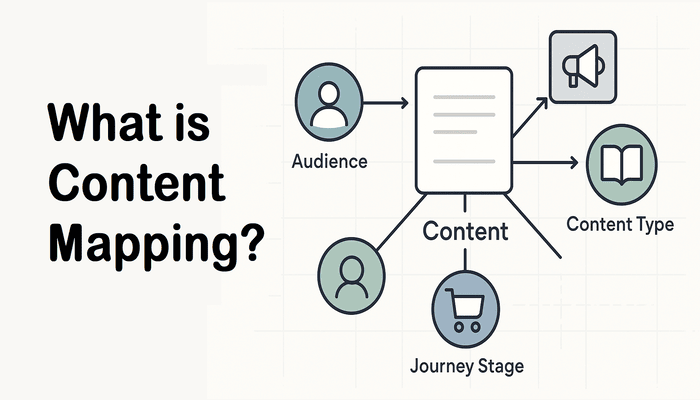
Content mapping is the process of aligning every blog post, service page, and email with a specific buyer persona and a specific stage of the customer journey. Instead of publishing content at random, you plan each piece around a real question a real buyer is asking, at the exact moment they’re asking it.
That distinction matters more in 2026 than it used to. Buyers now research through AI assistants like ChatGPT, Perplexity, and Gemini as often as they research through Google, and a large share of that research happens before your business ever gets a click. A content map built for search alone misses half the picture. A content map built for search and AI visibility together is what actually moves prospects toward a decision.
This guide breaks down how content mapping works, how AI has changed the buyer journey it’s built around, and how to put one together with real examples.
Why content mapping still matters in 2026
Content mapping exists to solve one problem: content that gets published without a clear reader or a clear purpose rarely converts. Mapping content to a buyer persona and a journey stage fixes that by making sure the right message reaches the right person at the right moment.
Three shifts make this more important now, not less.
Buyers do more research before you ever hear from them.
Multiple 2026 industry surveys put AI tool usage among B2B buyers above 90%, and buying committees on complex purchases now run 11 to 14 stakeholders on average, up sharply from a decade ago. Your content has to answer questions for people you’ll never speak with directly.
Search results answer questions before a click happens.
AI Overviews and zero-click results now resolve a large share of Google searches without sending traffic anywhere. Ranking well no longer guarantees visibility, let alone a visit.
Content still has to prove it’s trustworthy.
Google and AI systems alike weight authorship, depth, and topical authority far more heavily than they used to. A thin page with the right keyword doesn’t compete the way it did five years ago.
Together, these shifts mean content mapping isn’t just a marketing nicety anymore. It’s the difference between content that gets found and content that gets skipped.
How to build a content map that works
A working content map starts with three things: who you’re writing for, where they are in the journey, and what they need from you at that moment.
1. Build your buyer personas
A buyer persona is a detailed, research-backed profile of your ideal customer, covering their demographics, motivations, pain points, and preferred channels. Getting this right shapes everything downstream, including your broader digital marketing strategy.
To build a solid persona:

Source – Autopilot
- Research your audience through existing data, reports, and surveys
- Validate assumptions with your own polls, interviews, or feedback loops
- Study competitors to spot gaps you can fill
- Group your audience by purchase behavior and lifecycle stage
- Treat the persona as a hypothesis you’ll refine over time
2. Map the buyer journey stages
Every buyer moves through three broad stages before making a purchase decision: awareness, consideration, and decision. This structure is the backbone of any B2B SEO strategy, since each stage calls for a different kind of content and a different keyword intent.
| Stage | Buyer mindset | Best content types |
| Awareness | Knows they have a problem, can’t fully define it | Blog posts, infographics, short videos, social content |
| Consideration | Understands the problem, comparing solutions | Comparison guides, case studies, how-to guides |
| Decision | Has a solution in mind, choosing a vendor | Reviews, demos, product pages, pricing guides |
In 2026, one more layer matters here: problem-unaware buyers, who haven’t started actively searching yet but are typing general questions into an AI assistant. Content that answers broad, exploratory questions well is now getting cited in AI-generated answers long before a buyer reaches Google.
3. Match content to each stage
Once personas and stages are set, map specific content types to specific needs.
Awareness stage
content should be broad, educational, and free of a hard sell. Blog posts, email newsletters, and short-form video work well here because they meet someone before they know a solution exists.
Consideration stage
content should help someone evaluate options. Comparison guides and case studies work because they show, rather than tell, why your solution holds up.
Decision stage
content should remove the final friction. Customer reviews, demos, and clear pricing pages give a buyer the confidence to act. This is also where AI Overviews and answer engines increasingly pull direct comparisons, so a decision-stage page needs a clear, extractable answer near the top, not buried three paragraphs in.

Source – SmartInsights
Content mapping tools worth trying
A content map can be as simple as a spreadsheet, but dedicated tools help at scale.
- Lucidchart: A drag-and-drop visual tool with real-time collaboration, useful for mapping content structures visually.
- Airtable: Combines spreadsheet simplicity with database features, useful for tagging content by persona, stage, and format.
- Smaply: Built specifically for customer journey and persona visualization, useful for teams that need a more storyboard-style view.
Once your map produces content worth promoting, pair it with a content amplification strategy so your best-performing pieces reach a wider audience instead of sitting unseen.
Content mapping examples
Example 1: Online course platform for small business owners
Persona: Sarah, a small business owner with limited time and budget for staff training.
- Awareness: “How Online Learning Empowers Small Businesses” (blog post), “Top Skills Every Small Business Owner Needs” (infographic)
- Consideration: “Best Online Course Platforms for Entrepreneurs” (comparison guide), a customer case study on revenue growth
- Decision: A free trial offer and a webinar on maximizing growth through the platform
Example 2: Home security system for first-time homebuyers
Persona: Alex, a first-time homeowner who wants an affordable, simple DIY setup.
- Awareness: “Why Every First-Time Homebuyer Needs a Security System” (blog post), a home safety checklist
- Consideration: A ranked comparison of DIY security systems, a beginner’s guide to smart home security
- Decision: An installation demo video and a clear, tiered pricing guide

Source – SEMRush
Final thoughts
Content mapping makes it easier to bring the right traffic to your site and, increasingly, to get cited in the AI answers that now shape a buyer’s shortlist before they ever land on a page. Start with your personas, map the journey honestly, and build content that answers real questions at every stage.
If you’re ready to put this into practice, an SEO services team can help turn this framework into a content plan built for both search and AI visibility.