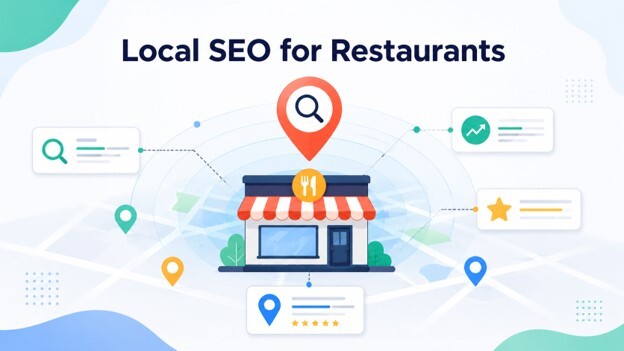
When looking for a place to eat, most people search “best brunch nearby” and pick from whoever shows up first. That’s why local SEO for restaurants matters so much. It decides whether you’re one of those first picks or invisible in the search results entirely.
But how does restaurant SEO actually work?
This guide explains the key steps to improve your restaurant’s local search visibility. You’ll learn how to optimize your Google Business Profile, improve your website, and appear in AI searches where most customers are searching.
You can also work with experienced restaurant SEO services that can manage the process for you. This way, you can focus on managing your business instead of handling SEO.
How Local SEO for Restaurants Works
Local SEO for restaurants means showing up in Google Maps and local results when nearby, hungry diners search for a place to eat. Your visibility depends on several key factors, including your restaurant’s location, the quality and quantity of customer reviews, and the completeness and accuracy of your business profile.
Understanding Google’s Local Pack
When someone searches for “best tacos near me,” Google displays three restaurants with map pins at the top of the search results. This is what we call the Local Pack. If your restaurant does not appear here, you will be losing high-converting customers who are ready to visit a place to eat.

Why Discovery Matters More Than Branding
Most people do not search for a restaurant by its name. According to Malou’s 2025 Digital Benchmark study, 79% of diners discover restaurants through searches related to the type of food they want, a nearby neighborhood, or a specific dish rather than by searching a restaurant’s name. So, a restaurant optimizing only for its own name stays invisible to potential customers.
Now, let’s see how you can actually optimize your presence to attract local customers.
Restaurant SEO Tips That Improve Local Search Rankings
Good local SEO helps more people find your restaurant when they search online. To improve your rankings, here are some practical restaurant SEO tips that work.
Complete Your Google Business Profile
Start by selecting a specific primary category that accurately describes your restaurant. For example, select “Vegan Restaurant” instead of the broader “Restaurant” if that matches your business. Then, add relevant secondary categories, include a direct link to your menu, and complete details such as outdoor seating, delivery, takeout, and reservation options.
Also, make sure to regularly upload high-quality photos of your actual dishes, dining room, and exterior. Up-to-date images help customers know what to expect and show Google that your business information is current.
Keep Your Business Information Consistent
Make sure your restaurant’s name, address, and phone number are exactly the same on every platform, including Google, Yelp, OpenTable, and food delivery apps.
For example, if your restaurant moved to a new location but DoorDash still displays the old address, customers may go to the wrong place. Conflicting information also makes it harder for Google to trust your business listing, which can lower your local search rankings.
Get More Value From Customer Reviews
Local customer reviews influence both search rankings and dining decisions. According to a BrightLocal 2026 survey, 31% of consumers now only use businesses with more than 4.5 stars. So, make sure to reply to every review, whether it is positive or negative.
When customers mention specific dishes or experiences, respond with thoughtful and personalized replies. Regular responses show that your restaurant values customer feedback and cares about their dining experience. This helps build trust with future customers and makes you seem more credible to Google.

How to Build an SEO Strategy for Restaurants
A working SEO strategy for restaurants combines three things: the right local keywords, content tied to the neighborhood, and a handful of genuine local mentions. Each piece reinforces the others.
Target Keywords That Align With Your Menu
General keywords like “Italian restaurant” are highly competitive and do not always attract people who are ready to visit a restaurant. Instead, focus on keywords that combine a specific menu item with a neighborhood or city name.
For example, you can use “birria tacos East Austin” instead of “tacos near me.” This type of search usually comes from someone who already knows what they want to eat and is looking for a nearby restaurant. Building your keyword and topical strategy around these specific searches can help you rank in search results more quickly than relying on broad keywords alone.

Write for Your Neighborhood
Your website should include content that connects your restaurant to the local community. Mention your neighborhood by name, highlight nearby landmarks, and write about local events that relate to your business, such as a fall festival, a farmers market, or a home game weekend. Publishing blog posts about these local events gives Google fresh, location-specific content to index.
Earn Local Mentions
Build your restaurant’s local reputation by earning mentions from trusted businesses and organizations in your community. For example, a review from a local food blogger, a news article about your new menu, or recognition for sponsoring a neighborhood event can all strengthen your local search presence.
How AI Search Is Changing Restaurant SEO
Besides traditional Google searches, AI tools such as ChatGPT, Gemini, and Google’s AI Overviews are now changing how people find restaurants. According to BrightLocal’s 2026 Local Consumer Review Survey, 45% of consumers now use AI for local recommendations, which was just 6% the previous year. Instead of searching Google for “Where should I eat tonight?”, many people now ask ChatGPT or another AI assistant the same question.
So, how do you stay visible in these searches? Here’s what to do.

Structure Your Menu and Website Content
AI tools and Google’s AI Overviews rely on well-organized website content. They can understand text much better than images, so avoid using image-only menus. Instead, publish your menu as regular text with clear dish names, descriptions, and prices whenever possible.
Use descriptive headings to organize your pages, and add schema markup to help search engines understand your restaurant’s information. A clear website structure improves your chances of ranking in Google’s AI Overviews and traditional search results.
Answer Common Customer Questions
AI systems index content that gives a direct and complete answer to a specific question. Include short sections on your website that clearly explain important details, such as your business hours, price range, signature dishes, parking options, or outdoor seating.
Write these answers using the same wording that customers are likely to use. For example, answer questions like “What is the best brunch patio downtown?” or “Does your restaurant offer vegetarian options?” When the same information appears consistently on your website, business listings, and other online profiles, AI tools are more likely to trust it and recommend your restaurant.
Final Words
Local SEO for restaurants means strengthening local signals, building credibility, and implementing structured data. However, managing these SEO tasks alongside daily restaurant operations can be difficult. As a result, many restaurant owners partner with a specialized digital marketing agency to ensure their local presence remains accurate and competitive.
At PNC Logos, we help build, manage, and optimize these local SEO signals for you. Our team helps convert nearby searches into consistent foot traffic to your business through personalized SEO strategies. Contact us today to get started.