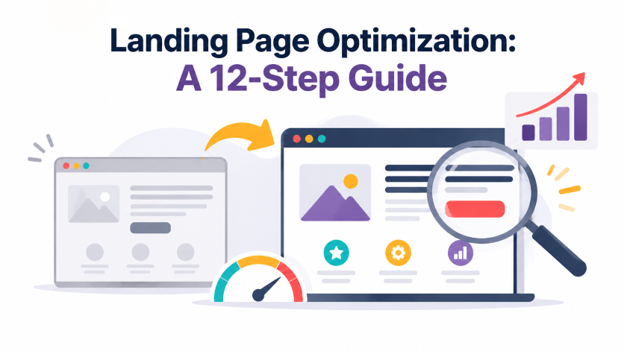
Landing page optimization improves your content, design, usability, and page performance to turn more visitors into customers. A well-optimized page gives visitors the information they need, presents relevant offers, and makes it easy to take action. For PPC campaigns, landing page relevance and user experience also affect ad performance and cost per lead.
This article gives you a practical 12-step guide to optimize your ad and service landing pages. Professional web design can also help bring these elements together through responsive, SEO-friendly layouts that guide visitors toward taking action.
Landing Page Optimization – The Essential Steps
Landing page optimization ensures your pages deliver exactly what visitors expect after clicking, so they convert and not just visit your page. Here are the 12 landing page best practices to increase conversions.
Step 1. Set a Conversion Baseline
Start by checking how your landing pages perform before making any changes. Your baseline is the conversion rate for each traffic source over a full ad cycle. It gives you a clear way to measure whether your optimization efforts are working.
For example, Unbounce’s study of 41,000 landing pages found a 6.6% median conversion rate across industries in Q4 2024. Use median rates as your benchmark to evaluate performance and identify areas for improvement.
Step 2. Match Each Page to the Visitor’s Search Intent
Your landing page should deliver exactly what brought visitors there. This is called message match. It means keeping your page’s headline, offer, and content consistent with the ad or search result.
Google Ads Help lists landing page relevance as a key factor in ad quality. For example, if your ad offers a free DUI consultation, make that same offer clear on the landing page. Include the primary search keyword in your H1 and keep the messaging consistent with the ad. Visitors should immediately know they’ve landed in the right place.

Step 3. Create a Dedicated Page for Each Campaign
Sending visitors to your homepage or a general practice area page gives them too many choices. Create a dedicated landing page for each ad group instead. Give each page a URL that matches its campaign.
Google also considers landing page experience when calculating Quality Score, which can affect your cost per click. Make sure each landing page matches its ad and gives visitors a clear path to conversion.
We put this approach into practice in a Google Ads campaign for Home Instead, a home care service in Henderson, Nevada. By combining precise geo-targeting with conversion-focused landing pages, PNC Logos increased monthly conversions from 36 to 58 in just 3 months. The cost per conversion also fell 21%, and CTR increased from 20.21% to 23.91%.
The same strategy is central to our PPC management services, where we align ad targeting and landing page content to turn more clicks into conversions.
Step 4. Write Headlines and Copy That Drive Action
Start with a clear, benefit-focused headline that tells visitors what they can gain from your offer. Then use the body copy to answer their main questions without making them dig for information.
Lead With the Outcome
Tell visitors what they can expect from your product or service right away. Use the sub-headline to add supporting details, build trust, or explain the next step. SEO content writing services can help you create clear, relevant copy that addresses the needs of both paid and organic visitors.
Match Reading Level
Keep technical industry jargon to a minimum and explain complex terms in plain language. Unbounce’s legal conversion data shows that college-level copy converted at 7.2%, compared with 5% for professional-level copy.
Step 5. Design the Page Around a Single Goal
A conversion-focused website design uses a goal-specific layout and navigation choices to keep visitors focused on the desired action. The action can be any specific task, such as submitting a form or booking a consultation. Repeat the same call to action at logical points so other elements do not compete for attention.
A few other steps that help:
- Remove the site navigation and any links that take visitors away from the landing page.
- Use a CTA button with a color that stands out from the page background
- Use whitespace and short text blocks to make the form stand out
- Arrange the page elements to guide visitors from the headline to supporting proof and finally to the call to action.
Step 6. Make Mobile Experience the Priority
Start with the mobile layout, then adapt it for larger screens. According to live data from StatCounter, 59.9% of website visits come from mobile devices, compared to 38.51% from desktop. This means your page needs to work well on a small screen to convert these visitors into customers.
You can do this by making buttons easy to tap and placing a sticky call button where visitors can reach it from any scroll position. Also, keep your forms short and simple so visitors can fill them out without zooming in.
Step 7. Learn from Landing Page Examples That Convert
The best landing pages have a benefit-focused headline, one clear call to action, and visible social proof, such as customer testimonials or client logos. Here are a few examples that embody the best landing page design tips.
Figma’s Focused Hero Section
Figma’s homepage opens with the headline “The full stack creative canvas” and places a single “Get started” button right beside it. After introducing the product features from the end-user perspective, customer logos and a testimonial follow. This layout gives visitors an immediate reason to trust the brand.

NordVPN’s Well-Placed Offer
NordVPN puts its current offer, “Black Friday: Get 78% off + 3 extra months,” right next to the “Get NordVPN” button. Just below, it displays a “30-day money-back guarantee.” This way, visitors see both the incentive and the reassurance they need to make a decision.

Step 8. Fix Speed and Core Web Vitals
Google uses three Core Web Vitals to measure page experience, applied at the 75th percentile:
- Loading within 2.5 seconds (LCP)
- Responding to interactions within 200 milliseconds (INP)
- Keeping layout shifts at 0.1 or less (CLS).
To improve these scores, compress larger images and lazy-load images below the fold. Remove unused JavaScript, tracking tags, and plugins to speed up loading and improve responsiveness. Technical SEO services can help identify and fix these performance issues.
Step 9. Add Verifiable Trust Signals
Visitors want proof they can trust your site and the services you offer. That’s where trust signals come in. Google also recommends using customer reviews as an example of useful, original information that landing pages should provide.
Make your trust signals easy to spot. Display your review count and rating, name the review platform, and add relevant certifications or award badges. Real evidence builds more trust than generic marketing promises.

Step 10. Make Lead Capture Easy
Visitors should be able to contact your firm through a form, phone call, or message without jumping through hoops. Every extra form field or unanswered call creates another chance to lose a potential client.
Keep Forms Short:
Ask for only the essentials: a name, contact information, and a brief description. Let visitors know what happens after they submit the form. A simple form also supports a broader website conversion strategy that guides visitors toward taking action on every page.
Don’t Miss Phone Calls:
According to CallRail, healthcare providers have the highest rate of missed calls at 32%, followed by law firms at 28%. A missed call means a missed project. Use call tracking to identify which landing pages generate calls. Set up after-hours call answering and send text messages to follow up on missed calls.
Step 11. Optimize for Search and AI
Modern landing page optimization helps search engines understand your content and makes it easier for AI tools to reference your pages. This means including a unique title tag, a descriptive URL, answer-first content, and relevant schema markup.
AI summaries are also changing how people interact with search results. In Pew Research Center’s study, only 8% of visits with a Google AI summary resulted in a click on a regular search result, compared with 15% of visits without one. So, make each visit count by giving people clear information and an easy way to contact you.
Step 12. Test, Track, and Improve Monthly
Run one A/B test at a time on headlines, offers, buttons, or forms. Track cost per lead for each traffic source, too. And give tests enough traffic before choosing a winner. If your page attracts a high volume of visitors, you can also experiment with multivariate testing to compare several elements at once.
Final Words
Landing page optimization includes matching search intent, focusing on one action, improving page speed, and testing regularly. Even one weak point, such as slow loading, can drive up your cost per lead. A specialist team can help keep every part of the process on track.
At PNC Logos, we combine web design, PPC management, SEO content, and technical SEO to create fast, relevant, and conversion-focused ad and service landing pages. With an integrated approach, our team improves your website’s user experience, increases conversions, and lowers your cost per lead. Get in touch today.